
Your smart home can have excellent lighting, premium automation, and beautiful control panels. But if the network underneath them isn't properly designed, the experience can still be frustrating. That's because modern smart homes depend on communication.
Lights, controllers, touchscreens, cameras, AV systems, access devices, and other connected equipment all need a dependable network environment.
Your internet connection isn't the same thing as your home network.
This is an important distinction. Your fiber internet provider gives you an internet connection.
Your home network is the infrastructure that distributes that connection and allows your devices and systems to communicate within the property.
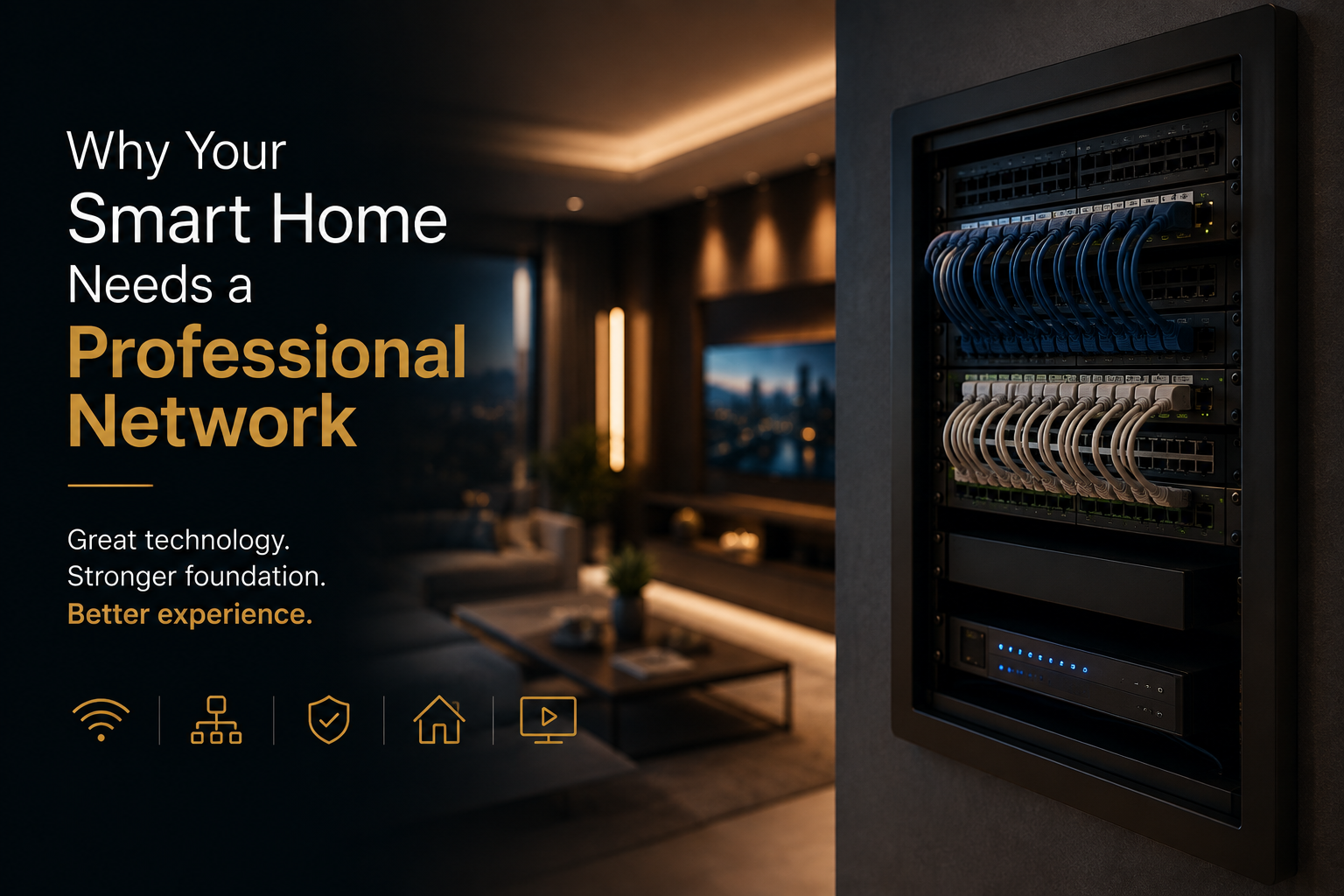
A professionally designed smart-home network considers things such as:
- Wi-Fi coverage
- Network switching
- Wired connections
- Access point placement
- Device capacity
- Network segmentation
- Security
- Reliability
- Redundancies
Why does that matter?
Imagine a home with:
- 20+ smart devices
- Multiple cameras
- Several access points
- Whole-home audio
- 4K streaming
- Control interfaces
- Lighting control
- Security systems
- Automated shades
Everything may work perfectly when the house is quiet.
But add several people streaming 4K/8K video, making video calls, using phones, controlling the home, gaming, and accessing cameras at the same time — and the network suddenly becomes part of the smart-home experience.
A professional network is infrastructure, not decoration.
For a serious residential automation project, the network should be considered early in the design.
Good planning helps ensure that the systems being installed have the connectivity they require.
That is particularly important for larger homes where Wi-Fi coverage, device density, wired infrastructure and traffic management become more demanding.
The objective isn't simply:
“Get stronger Wi-Fi.”
It's:
“Build a network that the home can depend on.”
Your smart home is only as dependable as the infrastructure supporting it.
That's why networking should not be treated as an afterthought.
At GEEP Engineering, we consider networking as part of the wider residential technology system — alongside automation, lighting, entertainment, security and other connected systems.
Because when everything works together, the homeowner shouldn't be thinking about the network at all.
It should simply work.