What Cloud-Based AV Management Actually Means
It's easy to hear "cloud-based" and assume it just means remote access — logging into a system from home instead of walking down the hall. But that undersells what's actually possible.
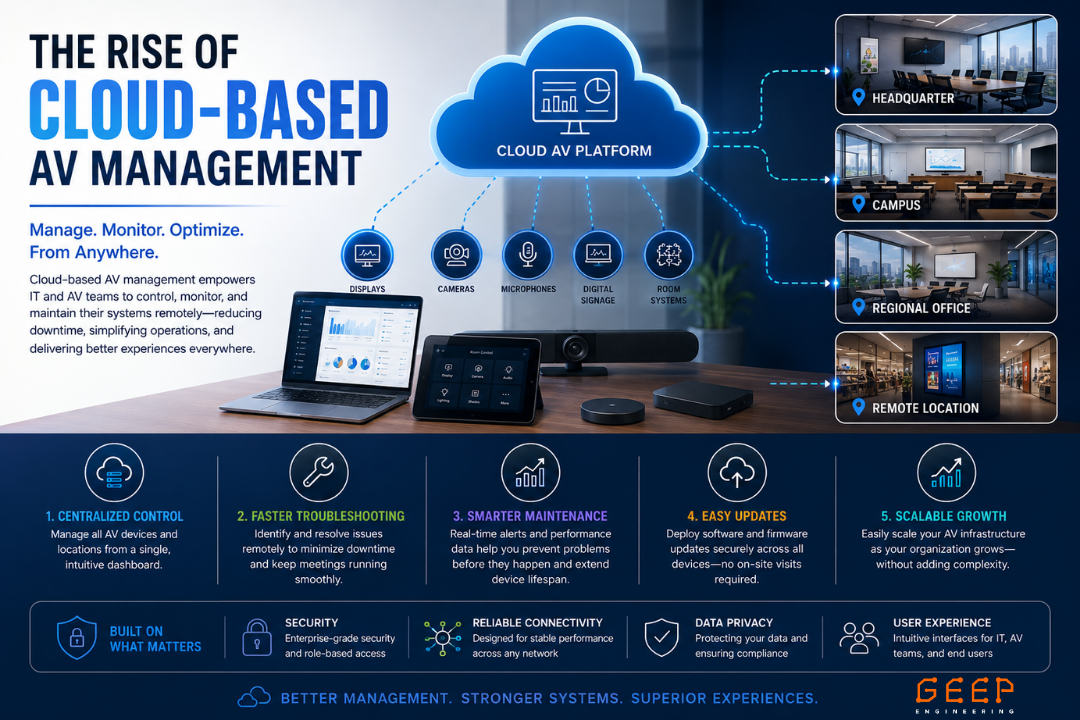
Cloud-based AV management includes
- Centralized monitoring of every connected device, across every room and every site
- Automatic firmware updates pushed out without a technician needing to be physically present
- Real-time diagnostics that catch problems as they emerge, not after someone complains
- Remote control of entire device networks from a single interface, regardless of location
When these capabilities are implemented intentionally, not bolted on as an afterthought, they change the fundamental nature of an AV deployment. Instead of a patchwork of isolated rooms, each with its own quirks and blind spots, you get one connected, manageable ecosystem. The room-by-room mentality gives way to a systems mentality.
That distinction matters more than it might sound. Isolated rooms fail in isolation, get diagnosed in isolation, and get fixed in isolation, which is slow, expensive, and hard to scale. A connected ecosystem behaves very differently.
Why It Matters
Centralized Visibility & Control: In a traditional AV setup, checking on equipment means physically visiting the room or worse, waiting for someone to report that something's wrong. With cloud-based management, integrators and IT teams can monitor displays, audio systems, and conferencing tools from a single dashboard, regardless of how many rooms or sites are involved. This doesn't just save time. It changes the relationship between the support team and the equipment. Instead of reacting to scattered, disconnected installations, teams get one coherent view of the entire environment, which means faster response times and fewer surprises.
- Faster Troubleshooting & Reduced Downtime: Cloud platforms are built to flag issues automatically: a disconnected device, a failing component, a software conflict. Often, these are caught before a user ever notices something is wrong. This is the difference between reactive firefighting and proactive maintenance, and in corporate and education environments, that difference is enormous. A boardroom that goes dark five minutes before a client presentation, or a lecture hall where the projector fails mid-class, isn't just an inconvenience. It's a credibility problem. Cloud-based diagnostics exist precisely to prevent those moments.
- Scalability Across Multiple Locations: For organizations with offices, campuses, or venues spread across cities or countries, the old model of AV support — a local technician on call at every site simply doesn't scale. It's expensive, inconsistent, and slow. Cloud management removes that constraint. Updates, configurations, and troubleshooting can happen across dozens or hundreds of locations without a corresponding increase in headcount. Growth in the number of rooms no longer has to mean growth in the size of the support team.
- Stronger Security & Compliance: AV systems are no longer separate from an organization's broader IT network; they're part of it. That means AV inherits the same security expectations as any other connected system: consistent firmware updates, defined access controls, and predictable patching schedules across every device. Cloud platforms make this consistency achievable in a way that manual, room-by-room management never could. In an industry where AV increasingly touches sensitive networks and data, this isn't a nice-to-have anymore. It's essential.
- Cost Efficiency for Clients: All of the above adds up to a straightforward financial case. Fewer on-site visits. Faster fixes. Predictive maintenance that prevents costly failures before they happen. Together, these translate into meaningfully lower long-term operational costs. For clients, this often marks a shift in how AV itself is perceived — from a line-item overhead cost to a smart, manageable investment that pays for itself in uptime and reduced support burden.
Beyond convenience, it would be easy to file cloud-based AV management under "nice-to-have" — a convenience feature for teams that want a bit less legwork. But that framing misses the point.
This is about building systems that are inherently easier to maintain, faster to troubleshoot, and genuinely ready to scale as organizations grow. It's the difference between AV infrastructure that becomes more fragile as it expands, and AV infrastructure that becomes more resilient.
The future of AV design depends on how well cloud management gets integrated into systems not as something added after installation, but as a core part of how systems are designed from the very beginning.
That's a meaningful shift in mindset for integrators and clients alike. It means asking different questions at the design stage: How will this system be monitored? How will updates be deployed across every room? How will problems be caught before they become downtime? Getting these answers right from day one is far easier and far cheaper than retrofitting them later.
We help organizations design AV systems that are easier to manage, faster to troubleshoot, and built to scale.
If that's something you're thinking about for your space, reach out at
📧 Email: hello@geepengineering.com
🌐 Explore our work: www.geepengineering.com
#AVDesign #CloudComputing #SmartTechnology #AVIntegration #SystemIntegration #RemoteManagement #FutureOfWork